
The Forward-Looking Project Funded by Erasmus+: Transforming Green Competence Certification Through 8 Strategic Policy Visions
MASTERY – "Micro-credentials Reliability Unleashing Green Economy" is a forward-looking initiative funded by the Erasmus+ Programme. The project is redefining the European approach to micro-credentials. Coordinated by SFC Sistemi Formativi Confindustria and implemented by a consortium of eight partners, the project introduces a structured framework for systematically implementing micro-credentials in key sectors of the green transition. It bridges the critical gap between European policy vision and concrete industrial needs.
The project primarily targets vocational training institutions while actively involving enterprises, universities, research centers, and public administrations that view the circular economy as a strategic priority. The transnational partnership spans Italy, Spain, Bulgaria, Belgium, and Finland, promoting collaboration between training providers and industry to innovate in green competence validation.
Three Strategic Objectives:
Developing Micro-Credentials Methodologies – Designing approaches to enhance lifelong learning with a focus on green competencies
Pilot Testing in the Field – Conducting pilot projects to test practical solutions within companies engaged in reskilling and upskilling
Policy Recommendations – Drafting a policy brief through co-decision processes to accelerate the transition towards a circular economy
The Methodology: 8 Visions Across 3 Strategic Phases
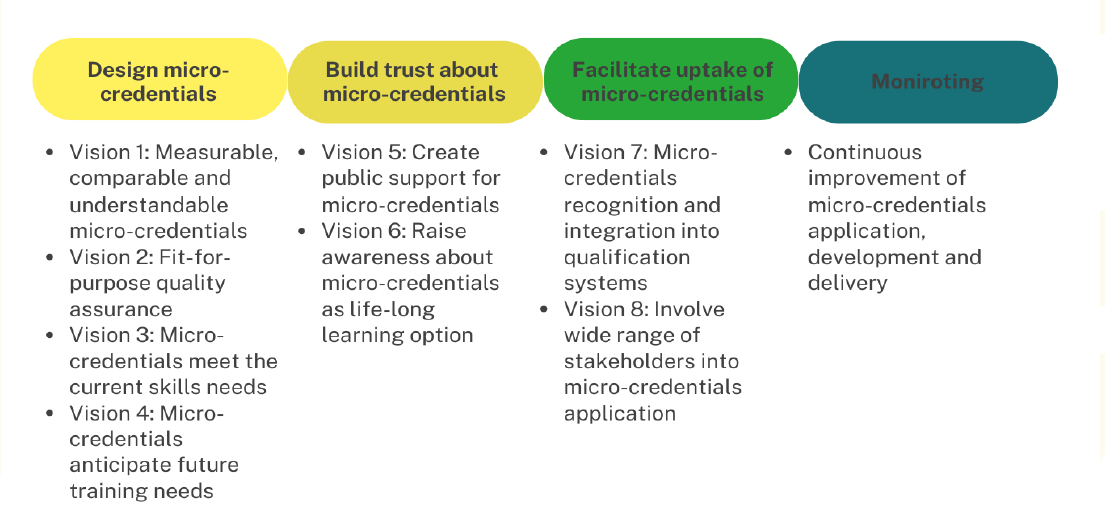
The MASTERY Policy Methodology is built on 8 validated visions. These were developed through multi-stakeholder consultations and organized into three strategic phases aligned with the EQAVET quality cycle:
Stage 1 – Design:
1 Micro-credentials that are measurable, comparable, and understandable
2 Fit-for-purpose quality assurance
3 Alignment with current skills needs
4 Anticipation of future training needs
Stage 2 – Trust Building:
5 Development of public backing for micro-credentials
6 Raising awareness and understanding of micro-credentials as lifelong learning opportunities
Stage 3 – Uptake Facilitation:
7 Recognition and integration into qualification systems
8 Multi-stakeholder involvement in implementation
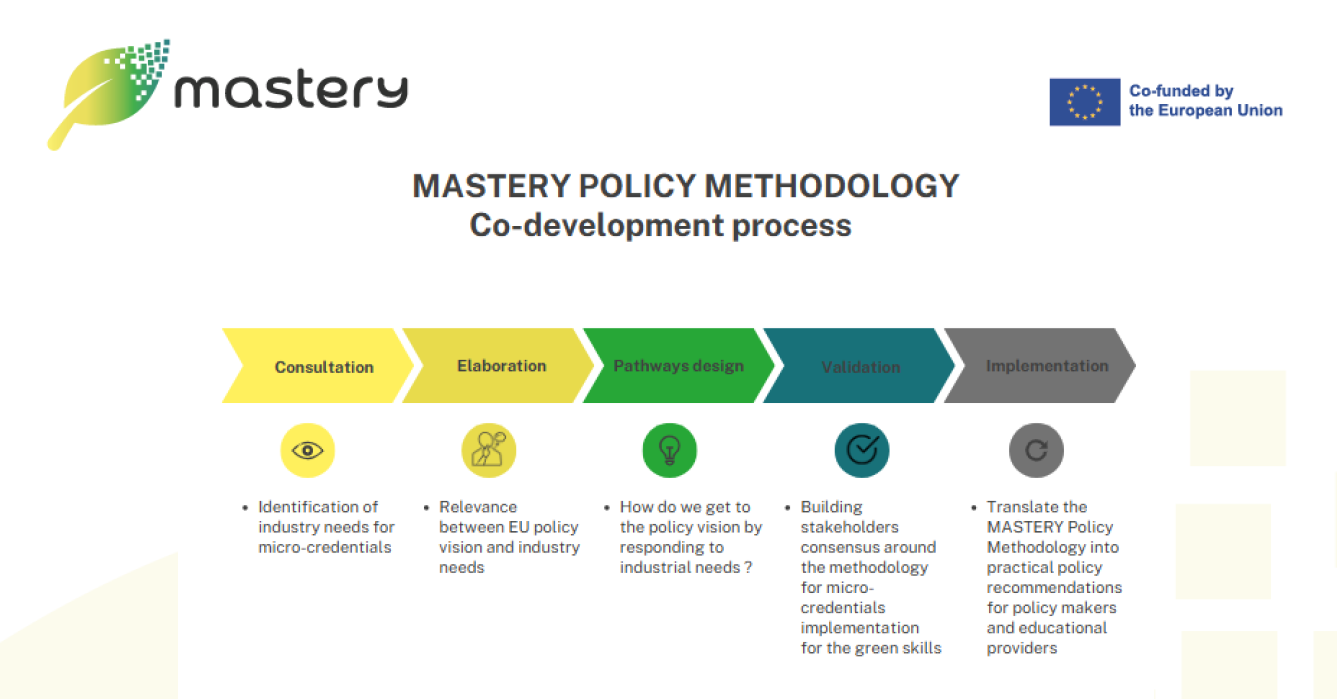
These 8 visions emerged from the MASTERY policy co-creation groups—multi-stakeholder teams that followed key steps in the co-creation process, summarized below:
Consultation: During the first 8 months of the project, multi-stakeholder consultations identified critical sectoral needs for the green transition. This enabled the development of targeted micro-credential pathways.
Development: Analysis of EU policy recommendations, VET system regulations in the five partner countries, and best practices on micro-credentials helped match EU political goals with workforce and individual needs.
Pathway Design: The MASTERY working group is now designing integrated training and certification pathways to implement the eight policy visions.
Validation: From January 2026, pilot centers will begin delivering MASTERY training and issuing micro-credentials.
Implementation: Results from these pilots—validated jointly by the co-creation groups—will inform operational recommendations to strengthen certification and recognition of green competencies.
The methodology proposes a governance model that concretely applies the principles of the June 2022 Council Recommendation. It uses technical standardization based on ESCO, EQF, EQAVET, and interoperable metadata for digital badges.
Stakeholder consultations highlighted major challenges addressed by the project. The chief challenge is the disconnect between policy vision and the operational capacity of training ecosystems. This gap, evident in the implementation of micro-credentials, requires differentiated approaches across countries with varying levels of VET development. It must be considered alongside the broader issue of ensuring that green-skill micro-credentials are "fit-for-purpose"—meeting production and labor needs while retaining sectoral flexibility and cross-border comparability.
Impact & Future Outlook
The project runs until December 2026, with two major phases:
Piloting of MASTERY micro-credentials: November 2025 to March 2026
Consolidation of methodology and recommendations: February to December 2026, reinforcing a multi-stakeholder governance model for micro-credential design and recognition
For SFC, MASTERY is a crucial testbed to strengthen the vocational training and micro-credential issuing system. It bridges professional demand and individual learning choices while supporting professional updating and reskilling.
In the first 18 months of the project, it became clear what micro-credentials are not. They are not shortcuts to accumulating credits, but rather meaningful diversifications of lifelong learning competencies. They are not replacements for already regulated education cycles, but specific training opportunities and know-how refreshers that empower individuals to engage in evolving work and social environments.
MASTERY is active in Italy through micro-credential programs delivered by:
- SFC Sistemi Formativi Confindustria
- Scuola Superiore Sant'Anna di Pisa
For more details, refer to the project website: https://mastery-microcredentials.eu/what-is-mastery/
The Forward-Looking Project Funded by Erasmus+: Transforming Green Competence Certification Through 8 Strategic Policy Visions
MASTERY – "Micro-credentials Reliability Unleashing Green Economy" is a forward-looking initiative funded by the Erasmus+ Programme. The project is redefining the European approach to micro-credentials. Coordinated by SFC Sistemi Formativi Confindustria and implemented by a consortium of eight partners, the project introduces a structured framework for systematically implementing micro-credentials in key sectors of the green transition. It bridges the critical gap between European policy vision and concrete industrial needs.
The project primarily targets vocational training institutions while actively involving enterprises, universities, research centers, and public administrations that view the circular economy as a strategic priority. The transnational partnership spans Italy, Spain, Bulgaria, Belgium, and Finland, promoting collaboration between training providers and industry to innovate in green competence validation.
Three Strategic Objectives:
Developing Micro-Credentials Methodologies – Designing approaches to enhance lifelong learning with a focus on green competencies
Pilot Testing in the Field – Conducting pilot projects to test practical solutions within companies engaged in reskilling and upskilling
Policy Recommendations – Drafting a policy brief through co-decision processes to accelerate the transition towards a circular economy
The Methodology: 8 Visions Across 3 Strategic Phases
The MASTERY Policy Methodology is built on 8 validated visions. These were developed through multi-stakeholder consultations and organized into three strategic phases aligned with the EQAVET quality cycle:
Stage 1 – Design:
1 Micro-credentials that are measurable, comparable, and understandable
2 Fit-for-purpose quality assurance
3 Alignment with current skills needs
4 Anticipation of future training needs
Stage 2 – Trust Building:
5 Development of public backing for micro-credentials
6 Raising awareness and understanding of micro-credentials as lifelong learning opportunities
Stage 3 – Uptake Facilitation:
7 Recognition and integration into qualification systems
8 Multi-stakeholder involvement in implementation
These 8 visions emerged from the MASTERY policy co-creation groups—multi-stakeholder teams that followed key steps in the co-creation process, summarized below:
Consultation: During the first 8 months of the project, multi-stakeholder consultations identified critical sectoral needs for the green transition. This enabled the development of targeted micro-credential pathways.
Development: Analysis of EU policy recommendations, VET system regulations in the five partner countries, and best practices on micro-credentials helped match EU political goals with workforce and individual needs.
Pathway Design: The MASTERY working group is now designing integrated training and certification pathways to implement the eight policy visions.
Validation: From January 2026, pilot centers will begin delivering MASTERY training and issuing micro-credentials.
Implementation: Results from these pilots—validated jointly by the co-creation groups—will inform operational recommendations to strengthen certification and recognition of green competencies.
The methodology proposes a governance model that concretely applies the principles of the June 2022 Council Recommendation. It uses technical standardization based on ESCO, EQF, EQAVET, and interoperable metadata for digital badges.
Stakeholder consultations highlighted major challenges addressed by the project. The chief challenge is the disconnect between policy vision and the operational capacity of training ecosystems. This gap, evident in the implementation of micro-credentials, requires differentiated approaches across countries with varying levels of VET development. It must be considered alongside the broader issue of ensuring that green-skill micro-credentials are "fit-for-purpose"—meeting production and labor needs while retaining sectoral flexibility and cross-border comparability.
Impact & Future Outlook
The project runs until December 2026, with two major phases:
Piloting of MASTERY micro-credentials: November 2025 to March 2026
Consolidation of methodology and recommendations: February to December 2026, reinforcing a multi-stakeholder governance model for micro-credential design and recognition
For SFC, MASTERY is a crucial testbed to strengthen the vocational training and micro-credential issuing system. It bridges professional demand and individual learning choices while supporting professional updating and reskilling.
In the first 18 months of the project, it became clear what micro-credentials are not. They are not shortcuts to accumulating credits, but rather meaningful diversifications of lifelong learning competencies. They are not replacements for already regulated education cycles, but specific training opportunities and know-how refreshers that empower individuals to engage in evolving work and social environments.
MASTERY is active in Italy through micro-credential programs delivered by:
- SFC Sistemi Formativi Confindustria
- Scuola Superiore Sant'Anna di Pisa
For more details, refer to the project website: https://mastery-microcredentials.eu/what-is-mastery/